
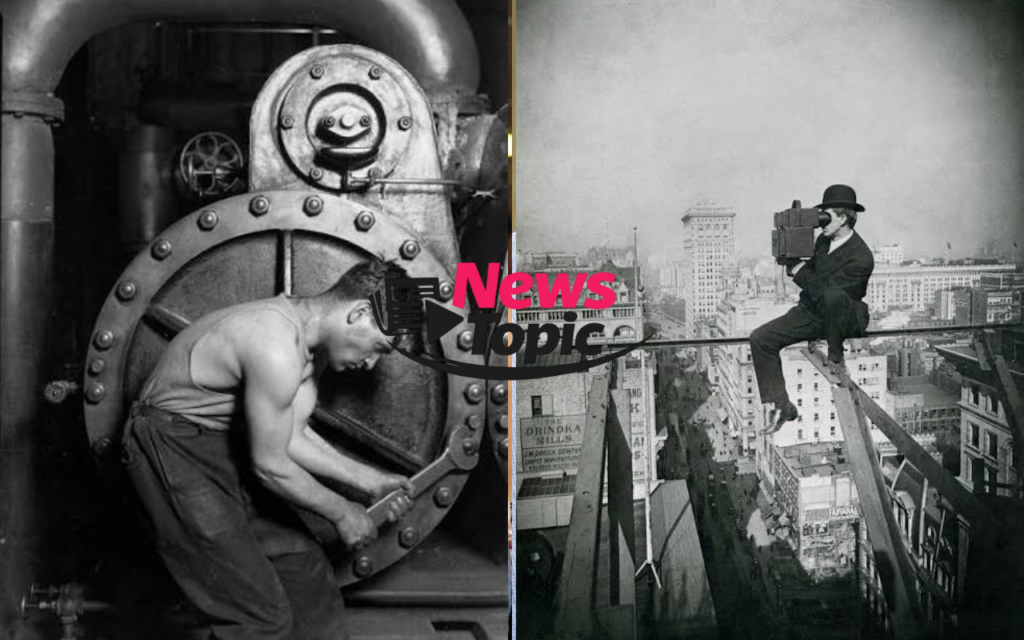

Lewis Hine stands among the most influential photographers in American history. More than simply a photographer, Hine was a sociologist, educator, reformer, and humanitarian who used the camera as a tool for social change. His photographs exposed child labor, documented immigrant experiences, celebrated workers, and helped shape the development of documentary photography. Through his images, Americans were confronted with realities that many had never seen before. His work transformed public opinion, influenced social reforms, and established photography as a powerful force for justice.
Today, Lewis Hine is remembered not only for his artistic achievements but also for his commitment to improving society. His photographs remain some of the most important visual records of the Progressive Era and continue to inspire photographers, historians, journalists, and activists around the world.
Early Life and Childhood
Lewis Wickes Hine was born on September 26, 1874, in Oshkosh, Wisconsin. He grew up during a period of rapid industrialization in the United States, when factories, railroads, and urban growth were transforming American society. Hine’s early years were marked by hardship. His father died when Lewis was still young, leaving the family in financial difficulty.
To support himself, Hine worked various jobs while pursuing his education. These experiences exposed him to the realities of labor and economic struggle. Unlike many intellectuals of his time, Hine personally understood the challenges faced by working-class Americans. These experiences would later shape the themes that dominated his photography.
Despite financial obstacles, Hine was determined to continue his education. He attended several institutions, including the University of Chicago, Columbia University, and New York University. His primary focus was sociology, a field that examines human society, social relationships, and institutions. This academic background became the foundation of his future work.
While many photographers approached their subjects from an artistic perspective, Hine approached them as a sociologist. He wanted to understand how people lived, worked, and interacted within society. Photography became the perfect tool for documenting those realities.
Becoming a Teacher and Discovering Photography
Before becoming a professional photographer, Hine worked as a teacher at the Ethical Culture School in New York City. The school promoted progressive education, social responsibility, and humanitarian values. These principles strongly influenced Hine’s worldview.
At the Ethical Culture School, Hine began experimenting with photography as a teaching tool. He encouraged students to use cameras to document their surroundings and observe social conditions. During this process, he discovered photography’s remarkable ability to communicate ideas and emotions.
Photography soon became much more than a classroom activity. Hine realized that a photograph could often communicate social realities more effectively than written reports or statistical data. Images could reach people emotionally while also providing factual evidence.
This realization changed the course of his life. He increasingly focused on photography as a means of education and reform. Rather than simply creating beautiful pictures, Hine wanted to use photography to expose injustice and encourage positive change.
The Ellis Island Project
One of Hine’s earliest major photographic projects focused on immigrants arriving at Ellis Island in New York Harbor. Beginning in the early twentieth century, millions of immigrants entered the United States through Ellis Island seeking freedom, opportunity, and economic advancement.
At the time, many Americans viewed immigrants with suspicion. Anti-immigrant attitudes were common, and newcomers often faced discrimination. Hine sought to challenge these stereotypes through his photography.
His Ellis Island portraits captured immigrants from dozens of countries. He photographed families carrying their belongings, children filled with curiosity, and workers hoping to build better lives. Rather than portraying immigrants as a social problem, Hine presented them as individuals with dignity, courage, and aspirations.
These photographs remain among the most significant visual records of immigration in American history. They provide a powerful reminder of the diverse backgrounds that helped shape the United States.
Hine’s Ellis Island work also demonstrated an important characteristic of his photography: empathy. He consistently sought to portray people as human beings rather than stereotypes. This human-centered approach would define his entire career.
The Rise of Social Documentary Photography
Lewis Hine is widely regarded as one of the pioneers of social documentary photography. Before Hine, photography was often used primarily for portraiture, artistic expression, or commercial purposes. Hine expanded the possibilities of the medium by using it to investigate social conditions.
His philosophy was straightforward but revolutionary. He believed photographs could educate the public, expose injustice, and inspire reform. Rather than remaining neutral observers, photographers could become active participants in improving society.
Hine combined the methods of sociology and photography. He carefully documented facts about his subjects while also creating visually compelling images. This combination of evidence and emotion made his work particularly effective.
The field of documentary photography that exists today owes much to Hine’s pioneering efforts. Modern photojournalism, investigative photography, and human rights documentation all reflect principles that Hine helped establish more than a century ago.
Working for the National Child Labor Committee
Lewis Hine’s most famous work began in 1908 when he started working for the National Child Labor Committee. This organization sought to eliminate child labor and improve conditions for working children throughout the United States.
During the early twentieth century, child labor was widespread. Millions of children worked in factories, textile mills, mines, farms, canneries, and city streets. Many children worked ten to twelve hours a day under dangerous conditions. Education was often sacrificed in favor of earning wages for struggling families.
Although reformers had long criticized child labor, many Americans remained unaware of its true extent. Employers frequently concealed child workers from inspectors and journalists.
Hine’s assignment was to document the reality of child labor. Armed with a camera and notebook, he traveled across the country gathering evidence. His mission was simple yet ambitious: show Americans what child labor really looked like.
Over the next decade, Hine created thousands of photographs that exposed the exploitation of children in workplaces throughout the nation.
Investigating Dangerous Workplaces
Documenting child labor was often dangerous. Factory owners did not want photographers revealing working conditions to the public. Hine frequently encountered hostility, threats, and attempts to prevent his work.
To gain access to factories and mills, he sometimes used disguises. He posed as an insurance salesman, fire inspector, industrial photographer, Bible salesman, or machinery representative. These disguises allowed him to enter facilities where photography was normally prohibited.
Once inside, Hine worked quickly. He photographed children operating machinery, carrying heavy loads, sorting materials, and performing other labor-intensive tasks. He also gathered detailed information about their ages, working hours, wages, and educational backgrounds.
Hine often recorded comments from the children themselves. These notes added powerful context to his images and strengthened the credibility of his documentation.
His willingness to confront powerful industrial interests demonstrated extraordinary courage and commitment.
Child Labor in Textile Mills
Among Hine’s most famous photographs are those taken in textile mills across the American South. These mills employed thousands of children, many of whom worked long shifts under difficult conditions.
Hine photographed young boys and girls standing beside enormous machines. Some workers were so small that they appeared dwarfed by the equipment around them. Many children looked exhausted from hours of repetitive labor.
The images revealed a stark contrast between childhood and industrial work. Instead of attending school or playing, these children spent their days in noisy factories filled with dust and machinery.
Hine’s photographs helped Americans visualize the human cost of industrial production. The images challenged assumptions about economic progress and forced viewers to consider who was paying the price for industrial growth.
Newsboys and Street Workers
Not all child labor occurred in factories. Hine also documented children working in urban environments. Newsboys, bootblacks, messengers, and street vendors often worked long hours in city streets.
These children faced numerous dangers, including traffic accidents, crime, poor weather, and exploitation. Many worked late into the night to earn small amounts of money.
Hine’s photographs of newsboys became particularly famous. He captured young boys standing on street corners, selling newspapers in crowded cities. Some appeared confident and independent, while others looked vulnerable and exhausted.
These images expanded public understanding of child labor by showing that exploitation existed not only in factories but also in everyday urban life.
Coal Mines and Industrial Labor
Another important aspect of Hine’s work involved documenting child labor in coal mines and other industrial settings. Children known as “breaker boys” worked long hours separating coal from rock and debris.
The work was physically demanding, dangerous, and often harmful to children’s health. Coal dust filled the air, and injuries were common. Hine’s photographs captured the harsh reality of these workplaces.
The images showed children with dirty faces, worn clothing, and expressions that reflected years of hard labor. These photographs challenged romanticized views of industrial work and highlighted the need for reform.
The Impact of Child Labor Photography
The impact of Hine’s child labor photographs cannot be overstated. His images appeared in magazines, newspapers, exhibitions, reports, and public campaigns. Reform organizations used the photographs to educate the public and advocate for legislative change.
For many Americans, Hine’s photographs provided the first visual evidence of widespread child exploitation. Statistics could be ignored, but photographs created an emotional connection that numbers alone could not achieve.
Public awareness increased dramatically as a result of Hine’s work. Citizens began demanding stronger protections for children. Reformers cited his photographs when arguing for labor regulations and educational reforms.
Although many factors contributed to the eventual decline of child labor, Hine’s images played a significant role in shaping public opinion and building support for change.
The Pittsburgh Survey
In addition to his work on child labor, Hine participated in the Pittsburgh Survey, one of the first comprehensive sociological studies of an American city.
Pittsburgh was a major industrial center, known for steel production and manufacturing. The survey examined working conditions, housing, health, immigration, and social life within the city.
Hine’s photographs documented factory workers, immigrant communities, crowded housing, and industrial landscapes. These images complemented written reports and statistical research.
The project demonstrated how photography could contribute to scientific investigations of social conditions. It reinforced Hine’s belief that visual evidence could strengthen public understanding of complex social issues.
World War I and Humanitarian Photography
During and after World War I, Hine worked for the American Red Cross. His assignments took him to Europe, where he documented the effects of war on civilians.
Many of his photographs focused on children affected by conflict. He captured images of displaced families, refugees, and communities struggling to rebuild their lives.
These photographs expanded Hine’s focus beyond American social issues and highlighted universal themes of resilience, suffering, and recovery.
His wartime work demonstrated that documentary photography could address global humanitarian concerns as effectively as domestic social problems.
Celebrating Workers and Human Dignity
Although Hine is best known for exposing injustice, he also celebrated the dignity of labor. He admired workers and believed they deserved recognition for their contributions to society.
Many of his photographs portray workers with respect and admiration. Rather than presenting laborers as victims, Hine often emphasized their skill, strength, and professionalism.
This perspective distinguished him from photographers who focused exclusively on poverty or hardship. Hine recognized both the challenges and the achievements of working people.
His photographs conveyed a deep respect for human effort and perseverance.
Photographing the Empire State Building
One of Hine’s most famous later projects involved documenting the construction of the Empire State Building during the early 1930s.
The project allowed him to create some of the most dramatic images of his career. Hine photographed steelworkers, riveters, and construction crews working hundreds of feet above New York City.
To obtain these images, Hine often placed himself in dangerous positions. He rode in baskets suspended high above the city to photograph workers at close range.
The resulting photographs showcased the courage, skill, and determination of the laborers who built one of America’s most iconic structures.
Unlike his child labor photographs, which exposed exploitation, the Empire State Building images celebrated human achievement and industrial progress. They remain among the most recognizable photographs in American history.
The Book Men at Work
Hine later published many of his worker photographs in a book titled Men at Work. The book highlighted the contributions of laborers to modern society and reflected his enduring respect for working people.
Through both text and photographs, Hine argued that workers deserved appreciation and recognition. The book remains an important example of documentary photography focused on labor and industry.
It also demonstrated Hine’s ability to balance social criticism with celebration of human accomplishment.
Photography Style and Techniques
Lewis Hine’s photographic style combined artistic composition with factual documentation. He carefully arranged images to maximize visual impact while maintaining accuracy.
One defining characteristic of his work was attention to detail. He frequently recorded names, ages, occupations, wages, and other information about his subjects.
Another characteristic was empathy. Hine consistently portrayed individuals with dignity and respect. Even when documenting poverty or exploitation, he avoided sensationalism.
His photographs often included environmental details that helped viewers understand broader social conditions. Machinery, workplaces, housing, and surroundings became important elements of his visual storytelling.
This combination of artistry and evidence made his work uniquely powerful.
Challenges in Later Life
Despite his significant achievements, Hine faced difficulties during his later years. Public tastes changed, and financial support for documentary projects declined.
Many of the reform campaigns that had supported his work came to an end. As a result, Hine struggled financially and found it increasingly difficult to secure assignments.
Although his influence remained substantial, he did not enjoy widespread recognition during the final years of his life.
His situation reflected a common challenge faced by many pioneering artists whose contributions are fully appreciated only after their deaths.
Death and Posthumous Recognition
Lewis Hine died on November 3, 1940, in New York. At the time of his death, his work was respected by specialists but not widely celebrated by the general public.
In the decades that followed, however, scholars, historians, and photographers increasingly recognized his importance. Museums, archives, and universities preserved his photographs and promoted his legacy.
Today, Hine is considered one of the greatest documentary photographers in history. His images are displayed in major museums and studied by students around the world.
His work continues to influence photography, journalism, sociology, and social activism.
Lewis Hine’s Lasting Legacy
The legacy of Lewis Hine extends far beyond photography. He demonstrated that images could influence public opinion, inspire empathy, and contribute to social reform. His photographs helped expose child labor, document immigration, celebrate workers, and advance the field of documentary photography.
Modern photojournalists, human rights investigators, and documentary filmmakers continue to follow principles that Hine helped establish. His belief that photography can serve truth and justice remains as relevant today as it was more than a century ago.
Perhaps Hine’s greatest achievement was his ability to make people see. Through his camera, Americans encountered the faces of children working in factories, immigrants seeking opportunity, and workers building the modern world. These images encouraged viewers to recognize the humanity of people whose lives might otherwise have remained invisible.
Lewis Hine did more than take photographs. He changed the way society understood itself. His camera became an instrument of reform, compassion, and historical memory. For that reason, he remains one of the most important figures in the history of photography and one of the most influential visual storytellers America has ever produced.
you may also read :Marriage During Russia’s Economic Transformation